Home › Search & AI Readiness
Search & AI Readiness
Search behaviour has shifted more in the past two years than in the previous decade. If your website was built — or last reviewed — before this shift, it may already be losing ground without you knowing.
How people search has changed
People don't just type keywords into Google anymore. They ask full questions. They use AI assistants to get direct answers. They read AI-generated summaries at the top of search results before ever clicking a link. And when they do click, they expect to land on something that immediately confirms they're in the right place.
Tools like Google's AI Overviews, Bing Copilot, ChatGPT, and Perplexity are now part of how a meaningful percentage of people find businesses, compare options, and decide who to contact. That number is growing.
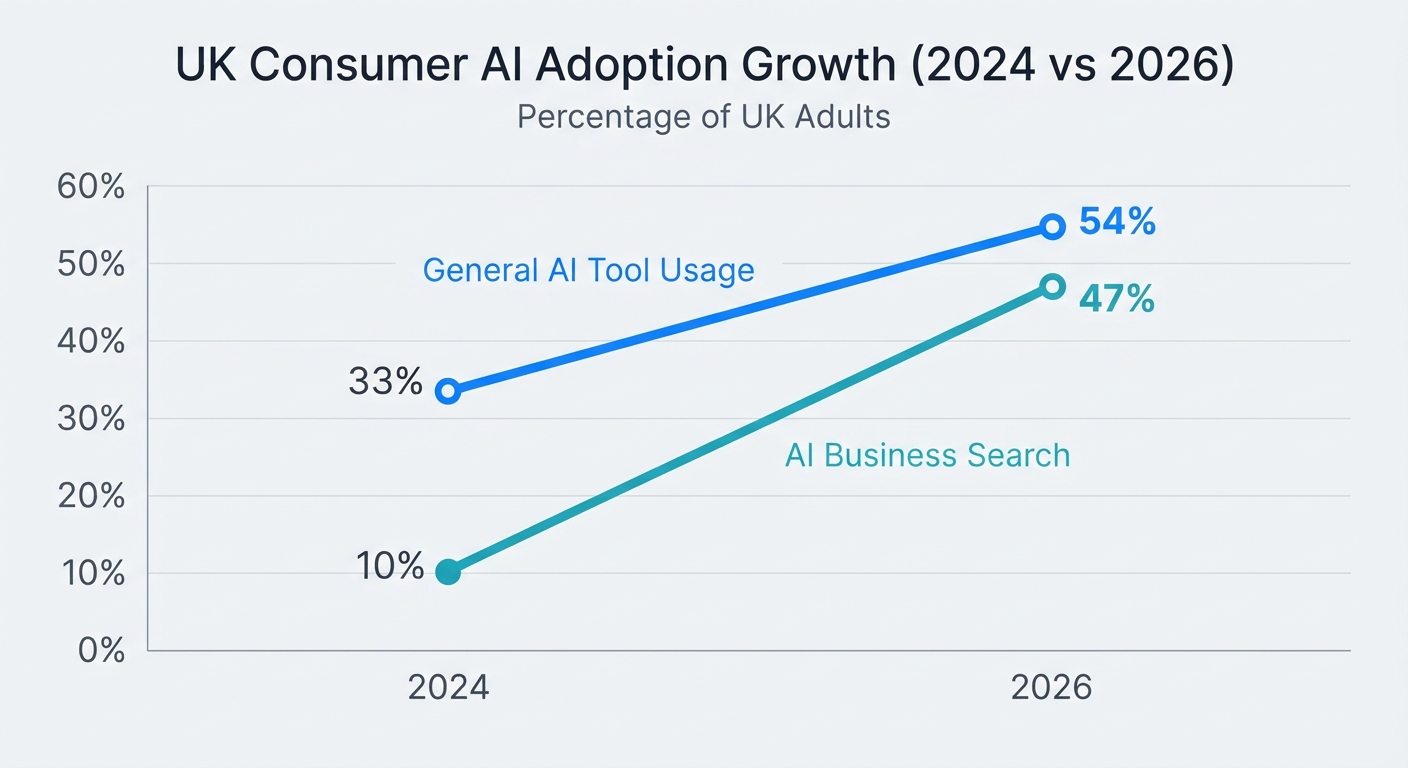
54% of UK adults now use AI tools (up from 33% in 2024) and 47% of UK consumers actively use AI-powered search to find and evaluate local businesses and services.
Despite this surge, fewer than 5% of UK SMEs have structured their websites to ensure AI crawlers can read, track, and ultimately recommend them. British businesses are largely invisible to AI algorithms.
These systems don't just index pages — they interpret them. They read your content, understand your structure, assess how well you answer specific questions, and decide whether your website is worth surfacing as a result. The criteria are different from traditional SEO, and many websites aren't meeting them.
What this means for your website
- → Clarity of content — AI systems reward websites that clearly state what they do, who they serve, and how. Vague or jargon-heavy content gets deprioritised or ignored entirely.
- → Structured information — headings, page hierarchy, and logical organisation help both search engines and AI tools understand and categorise your content accurately.
- → Answering real questions — websites that address the questions your customers actually ask — in plain language — are more likely to appear in AI-generated answers and featured results.
- → Technical soundness — page speed, mobile usability, and crawlability remain baseline requirements. A technically weak site will be deprioritised regardless of content quality.
- → Authority signals — consistent contact information, evidence of real expertise, and credibility indicators (testimonials, credentials, specific results) all influence how AI systems evaluate trustworthiness.
Why most small business websites aren't ready
Most small business websites were built to look good and rank in traditional keyword-based search. That was the right approach at the time. But the landscape has moved, and many of those sites haven't kept pace.
The issues are rarely dramatic — it's usually an accumulation of smaller things: content that's too vague, headings that don't reflect what customers search for, no clear answer to obvious questions, slow load times on mobile, no structured data. Individually, each one is manageable. Together, they add up to a website that modern search struggles to interpret and promote.
The businesses that adapt early — by making their websites clearer, better structured, and more directly useful — will have a significant advantage over those that don't.
The shift isn't coming. It's already here. The question is whether your website is positioned to benefit from it or be bypassed by it.
What the audit covers
The Search & AI Readiness section of the audit reviews your website against the criteria that matter most for modern search visibility:
- → How clearly your content communicates what you do and who you help
- → Whether your site structure and heading hierarchy support machine readability
- → Whether your content addresses the questions your customers are actually asking
- → The presence and quality of trust and authority signals
- → Technical factors affecting crawlability and indexing
Findings are written in plain language with specific recommendations — not a list of SEO metrics, but a clear view of where your site stands and what to do about it.
Need help making the changes?
If the search and AI readiness review identifies improvements you'd like help implementing, we can support that as a follow-on engagement. Just mention it when you get in touch.